
Package Matrix™
An Advanced Pricing Framework for Freelancers, Fractional Executives, Consultants and Creative & Professional Service Providers
By Shannon Mattern, creator of the Package Matrix™
What if you could significantly raise your prices without giving potential clients sticker shock?
What if you could prevent scope creep and being on call 24/7 for your clients before the digital ink is dry on your contract?
And what if you could make 2-3 times more per engagement without working 2-3 harder?
That’s what the Package Matrix™ Method makes possible for experienced consultants, coaches, fractional executives and professional, creative, technical and administrative service providers who know they aren’t charging enough, but don’t see how they can charge more without working even harder or pricing themselves out of the market.
TL;DR
The Package Matrix™ is an offer framework developed by Shannon Mattern, built on the premise that most service provider pricing failures are decision architecture failures. It structures any service offering into options mapped to pricing paradigms (investment-minded, hustle/hybrid-minded, and expense-minded) so clients make an empowered choice and providers earn more without over-delivering.

ABOUT THE AUTHOR
Shannon Mattern is a pricing strategist and the creator of the Package Matrix™. She is the founder of Web Designer Academy, where she spent a decade helping women web designers move from undercharging to premium pricing, and where she developed the framework now used by service providers across industries.
Table of Contents
The Package Matrix™ Method
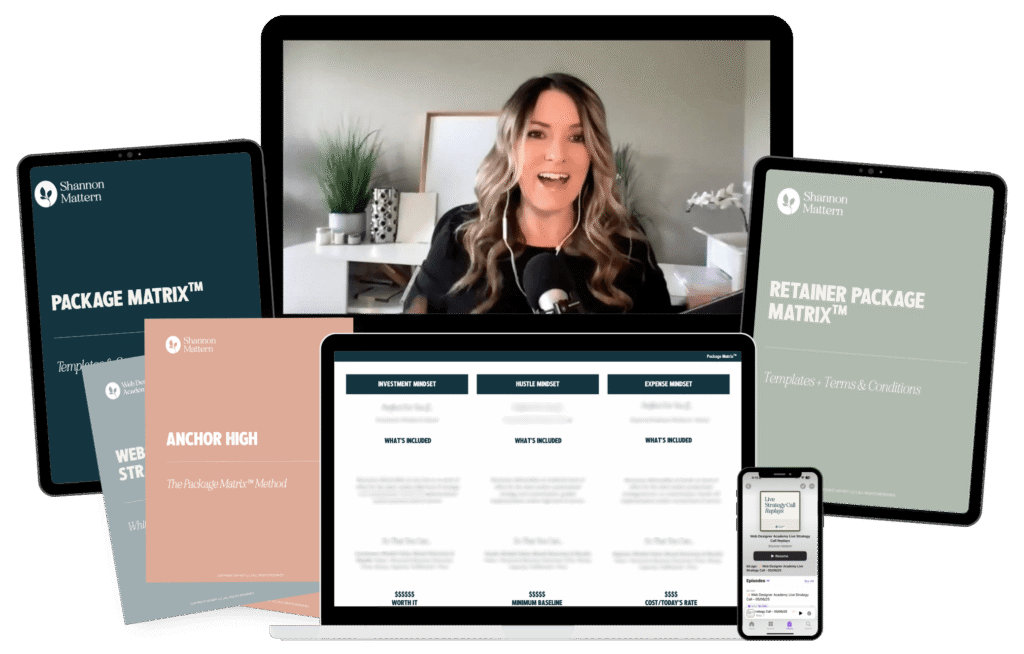
Close more proposals at higher prices, without working harder. The Package Matrix™ Method is the strategic pricing and sales methodology your service-based business has been missing (until now).
The Problem This Framework Solves
You left corporate for freedom and flexibility, yet somehow you find yourself working more than ever.
Your price seemed fair when you initially put together the proposal (even though you dropped the number right before sending it over, just enough so that you felt confident saying it out loud and confident they’d say yes), but now the engagement has ballooned well beyond what you originally discussed.
If you’re being really honest, you’re basically operating like a full-time salaried employee who doesn’t get paid overtime… and if you actually did the math, you’d see that you’re making a fraction of what you’d be making if you were actually on payroll.
So you just don’t do the math.
And when you think about the price you’d really need to charge for the level of effort you’re putting in to feel worth it, you can already see the sticker shock on their face.
Your plan was to leave corporate and build a multi-six figure practice/agency/consultancy while being in total control of your time and schedule – but with how much your current clients are demanding of you, you just don’t see how it’s possible.
You feel like you’re always behind, you’re working nights after the kids are in bed and grinding on the weekends, and you’re starting to feel like it wasn’t worth it.
And all the advice out there on how to fix it?
“Charge your worth.”
“Just raise your rates.”
“Stop billing hourly and use value-based pricing.”
“Productize your services and remove yourself from the delivery.”
“Switch to one-and-done intensives and ditch long-term contracts.”
It hasn’t solved your problem.
Maybe you’ve already ditched hourly and tried raising your rates to a number that feels aligned with your “worth” but either heard “that’s out of our price range” or worse, they said yes, but you’re hustling harder for them than ever and this whole freedom thing does not look like you thought it would.
Or maybe your engagements can’t be productized, or don’t work well in a condensed time-frame. Maybe that’s not how you want to work with clients. Maybe you don’t want to overhaul your entire business model. Maybe you don’t want to become a full-time marketer selling a product. Maybe you don’t want the intensity of an intensive or want to hustle to get as many clients as you’d need to fill your calendar.
I’m here to tell you that there is another way to charge significantly more for what you’re already doing, while working as much or as little as you want to, without completely overhauling your entire business model, giving your clients sticker shock or manifesting an abundance mindset.
And it’s called the Package Matrix™.
I developed it over nearly a decade of working with experienced, talented, high-level professional, creative and technical service professionals who were fully booked, yet under-earning and completely burnt out.
Because if you’re being really honest… when you think about how much more would be required of you if you charged more than you are now?
It doesn’t feel worth it.
There’s not a number out there someone could pay to keep hustling like this. You’d happily take less if it meant more freedom… but also, you’re very ambitious and have some big financial goals and you don’t want to settle for less, which is why you feel so stuck.
The good news is… you can have both: more money and more freedom – and it starts with the decision you put in front of your clients.
I’m here to tell you that there is another way to charge significantly more for what you’re already doing, while working as much or as little as you want to, without completely overhauling your entire business model, giving your clients sticker shock or manifesting an abundance mindset."
Shannon Mattern
What the Package Matrix™ Is
The Package Matrix™ is an offer framework for high-level service providers who sell their expertise and implementation, rooted in behavioral economics and built around a key insight:
Your clients might not think the same way you do about time and money.
After over a decade of coaching high-level service providers to grow their businesses, I observed three distinctly different sets of money beliefs at play on both sides of a transaction that massively influenced how a service provider packaged and priced their offers – and how the client made the decision to work with them or not.
I call these three sets of money beliefs Pricing Paradigms™.
Pricing Paradigms™
Pricing Paradigm™ #1: Investment Mindset
Investment-minded people value time more than money, and think about money in terms of future value and opportunity cost.
They’re not thinking about how much less they will have today if they say yes to your price, they’re thinking about how much more they will have in the future – more time, money, capacity, freedom.
They’re not thinking about what it will cost them to move forward, they’re thinking about what it will cost them to NOT move forward, and they understand the sooner they get started, the sooner they’ll experience the outcomes and results, which will compound over time.
Which is why it’s worth it to them to pay for a level of service and expertise that will empower them to experience better results faster.
They know they aren’t buying you – they are buying the outcome, and they know their own time is better spent elsewhere.
Pricing Paradigm™ #2: Hustle Mindset
Hustle-minded people are in growth mode and often value guidance over full-service delivery.
They want to learn, implement, and still get results without the trial and error of figuring it out entirely alone. They’re willing to allocate resources to do the work – whether it’s doing it themselves or delegating it to their team – as long as they’re confident they’re spending their time, resources and capacity on the right things.
Which is why it’s worth it to them to pay for guidance that will equip them to not waste time on things that won’t get them the outcomes and results they want.
Hustle-minded people are willing to work hard now so they can experience the benefits later.
Pricing Paradigm™ #3: Expense Mindset
Expense-minded people see money as a finite resource that is earned in exchange for their time. And since time is limited, money is also limited.
They believe they can raise the value of their time by gaining skills or expertise, but the amount of money expense-minded people believe they can make is always limited by how much time they have and how much they think someone else will pay for their skills.
Because they can only make money from their time, and they can only replenish the money they spend by selling more time, they move carefully when it comes to parting with their money – and for them, money becomes more valuable than time.
Which is why it’s worth it to them to spend more of their time to get the outcomes they want so they can keep more of their money.
Expense-minded people aren’t “broke” or “cheap” – they simply view money as more valuable than time and would rather spend their time over their money.
How Pricing Paradigms™ Affect Your Bottom Line
You probably think that every time you send over a proposal, your client is making a decision based on their budget compared to your price.
Which is only true because that’s the binary yes/no price decision you’ve likely been putting in front of them.
The traditional proposal process goes something like this:
Here are your goals, here’s the gap, here’s everything I’ll do for you to help you close the gap. Here’s why I’m the best at this, here’s what I’ve done for other clients like you, here’s why you can trust me. This is the length of the contract and this is the investment. Do you want to work together, yes or no?
And one of three things happen:
- They get sticker shock and tell you they can’t afford it, or they just tell you they’re going to think about it, ghost and never respond to your followup.
- They say yes, and you go into hustle mode to live up to your proposal and make sure they’re happy and get their money’s worth, and find yourself overworking, overwhelmed and burnt out.
- They say yes, and soon they start asking you for little things you didn’t include in your proposal which feel like no big deal until you find yourself working from a hotspot in a restaurant parking lot on vacation while your family’s inside having lunch – and you’ll be just a few more minutes because you gotta take care of this one quick thing for your client…
The solution isn’t to just raise your rates, because the problem isn’t just your pricing.
- The problem is that your proposal was built through the lens of your default Pricing Paradigm™ and assumes that your potential clients also think about money the same way you do.
- The problem is that you’re not leveraging the principles of behavioral economics and how humans decide how to use their resources.
- The problem is that your single-option yes/no proposal is working against sales psychology and how the human brain reacts when asked to deviate from the status quo.
- The problem is that you think you’re selling yourself and your skills and experience, so the higher the price, the more impressive, responsive, and responsible you must be, which ironically has you keeping your prices lower than they really could be to keep the pressure low.
The solution is to put a different decision in front of your client, one that empowers them with choices and allows them to decide which one they value more – their time or their money – and that sells the value of outcomes and results instead of your time and skills.
That’s what a Package Matrix™ does.
The solution is to put a different decision in front of your client, one that empowers them with choices and allows them to decide which one they value more - their time or their money - and that sells the value of outcomes and results instead of your time and skills."
Shannon Mattern
The 4 Rules
A Package Matrix™ only works to help you sell more projects at higher prices without hustling harder or giving up your freedom if it follows four very specific rules based on key principles from the fields of behavioral economics and sales psychology.
If you skip any one of these rules, you just have a menu of services and you’re missing out on the true power of a Package Matrix™.
Rule 1: Options based on Pricing Paradigms™
A single option proposal feels like an ultimatum to our brains, and there’s a phenomenon called status quo bias that humans experience when faced with an ultimatum that causes us to choose the safer, known option of our current situation vs. the uncertain, unfamiliar choice of change, even if our current situation is painful.
When you offer choices instead of an ultimatum, our brains tend to make a choice rather than no choice.
And when those choices are mapped to Pricing Paradigms™, it’s even more powerful because there will be an option that resonates with how they like to use their resources (instead of there only being one option based on how you assume they like to use their resources, which might be totally wrong).
Rule 2: The options all lead to the same outcomes and results.
Each option in a Package Matrix™ will lead the client to the same outcomes and results.
What changes between the options isn’t what they get, it’s how they get there.
Think of it like flying.
You can choose to fly from New York to LA via First Class, Business Class or Economy, and no matter which option you choose, you get from here to there. You don’t get dropped off halfway and get yourself the rest of the way there – you just get to decide what you value more, the convenience, comfort, and level of service or cost savings.
There’s no right or wrong answer, but the airline isn’t going to provide you with first-class levels of service when you chose an economy ticket.
And that’s the biggest opportunity almost every experienced high-level service provider I meet has to create more money and more freedom – to stop providing private-jet levels of service at business-class prices.
This rule is the one most people get wrong.
They’ll create different packages with different sets of deliverables and give the client a choice and think that they’ve solved their scope creep problem – but it’s still just a menu that’s setting the client up to make a decision on based on price – and worse, the more they pay, the more time it takes you to deliver and the harder you have to work, and it doesn’t take into account what I call “service-creep” – all the extra time you spend servicing the client that you didn’t account for even if the scope of the project doesn’t expand.
Rule 3: Pricing is value-based, not cost-based.
Cost-based pricing is a model that bases your price on your cost to deliver the service. The value you place on your time, skills and expertise, the costs of the tools and team you need to be able to deliver, your overhead, how long will it take you to deliver, your desired profit margin.
Cost-based pricing sets you up to have to prove and defend your price vs. every other service provider out there offering the same service you are, which is why you spend so much time in your proposals trying to prove you’re worth your price.
Instead, a value-based pricing model flips the script and asks: what is it worth to this specific client to reach this goal or have this problem solved? What is the total value of the outcomes and results – not just money, but time, capacity, physical, emotional and mental health?
Value-based pricing positions you as a market of one where you’re no longer justifying your price, you’re helping your client paint the picture of the true value of outcomes and results for themselves, and showing them how you’ll guide them there.
That’s a totally different decision the client is being asked to make: do I want to part with my resources temporarily for more resources in the future vs. do I want to part with my resources for your skills and experience?
It’s important to know your costs to deliver, but your cost is your floor. The value of the outcomes and results to the clients is the ceiling, and the ceiling is much higher than you might think when you factor in Pricing Paradigms™.
And the truth is that most service providers never get anywhere close to the ceiling because they’re making their price all about them instead of the client.
Rule 4: Always anchor high.
Behavioral economics tells us that the first number a person sees becomes the anchor against which all other numbers are evaluated.
When you talk about starting at prices, budgets or ranges that go from low to high, you’re setting a low price anchor – and then any number you discuss that is higher than that anchor creates the psychological experience of prices rising.
We only have to look at gas prices to see what most humans do when prices rise: they experience a fear response, and they conserve what resources they have, even if they have more than enough resources. They wait. They’re slower to make decisions.
But when you anchor high and present your highest-priced offer first and then as the price decreases, it actually creates the feeling of relief. You avoid that fear-response that kicks the brain into conservation mode, and your client is able to make a forward-thinking decision about future outcomes and results instead of safety today.
And when the value of the outcomes and results are the same across options in your Package Matrix™ and you anchor high in price and value, you’re establishing the ceiling, the value of working with you at the highest level, while positioning your mid-level offer as the best value.
When you offer options based on Pricing Paradigms™, anchored high, you can expect more of your consultations to turn into clients at any level, and you can expect about 75% of those clients to choose your middle option when the Package Matrix™ matrix is structured correctly.
And when you’re no longer providing private-jet levels of service at business-class prices, you’re either making more for what you’re currently doing, or you’re working less and making the same amount of money. Win/win.
When you offer 3 options based on Pricing Paradigms™, anchored high, you can expect more of your consultations to turn into clients at any level, and you can expect about 75% of those clients to choose your middle option when the Package Matrix™ matrix is structured correctly."
Shannon Mattern
What the Package Matrix™ Is Not
A Package Matrix™ is not a pricing table or a way to display your offers on your website.
It’s not for selling products (there are different sales psychology and behavioral economics principles to apply for selling products vs. services).
It’s not for selling time (for example it’s not for selling 40 hours, 20 hours or 10 hours of services).
It’s not a gold/silver/bronze menu where clients get more features and deliverables at the gold level than you do at the bronze level.
It’s not a way to rip off clients, overcharge or manipulate people into spending more than it’s worth.
It’s not tiered pricing where clients get more if they pay more and get less if they pay less.
It’s not three different offers for three different client avatars.
It’s not three different packages arranged from highest to lowest price.
And it doesn’t just replace your current proposal – it’s one part of an overall offer strategy and framework that leads clients through making a value-based decision instead of a cost-based decision.
If you skip any one of these rules, you just have a menu of services and you’re missing out on the true power of a Package Matrix™.
If you skip any one of these rules, you just have a menu of services and you’re missing out on the true power of a Package Matrix™."
Shannon Mattern
The Origin
I built the first version of what would later become the Package Matrix™ in 2018 after interviewing a business consultant named Paul Klein on my first podcast.
Up until that conversation, I was running my business from an expense mindset: selling my time and skills as a freelance web designer, and hustling to increase the value of my skills and trying to build up a portfolio that would prove I was worth the prices I wanted to charge.
But deep down I never felt good enough.
I was self-taught through necessity via my day job, I didn’t have a degree in web design, and I always took it personally when my clients experienced any challenges in their business, as if it was the website’s role to make them successful and its fault if they struggled.
I was overworking, overwhelmed, and burnt out, and it felt like the only way to create the freedom I’d left my day job for in the first place would be to sell as many web design projects as possible at what I thought would be low enough prices that I could sell a lot of them, and then hire a team to help me deliver faster so I could focus on marketing and sales.
But even that wasn’t working. More clients meant more marketing, more administrative work, more people needing more things, and my low prices didn’t account for all that service creep.
I’d hit a revenue ceiling, and I couldn’t figure out how to break through it. And it wasn’t just me.
In 2016, I founded the Web Designer Academy where I was mentoring other web designers on getting clients, creating systems and processes, managing projects, dealing with difficult clients, setting boundaries, managing their time and handling scope creep and zombie projects.
And what I found is that once our students overcame that initial hurdle of getting clients, they started bumping up against the same challenges of success I was experiencing in my own freelance web design business.
And just getting the confidence to raise their prices without changing anything else worked up until a point, until they started hearing “That’s out of my price range, can’t I just hire someone from Upwork to do this?” or “Can’t I just build this myself?” (which was the late 2010’s version of “Can’t I just use AI to do this?”)
And so the question back then that everyone started asking was “Where do I find people who can afford the prices I need to charge to make this business profitable and sustainable for me?”
And every guru’s answer to this question is “Niche down, become the go-to-expert in one tool, one industry that you can own and charge a premium.”
Which usually required a big decision and a big pivot: first, choosing the right niche, followed by new branding, new website, new copy, new offers, new marketing strategy, new relationships needing to be built – and that kind of pivot doesn’t happen on a dime. It’s more like turning a cruise ship around – you gotta slow way down, the turn takes forever, it requires a lot of resources, and then it takes awhile to get back up to speed.
But after interviewing Paul on my podcast, it hit me that none of us had a pricing problem. We didn’t need to niche down, or find the super secret place where all the clients with money were hanging out.
It was a structural problem.
The traditional way we were taught to make offers as creative service providers was actually working against us.
We were making one offer at one price and asking a client to decide whether we were worth it.
And clients kept defaulting to “let me think about it” or “I can’t afford it,” which I later learned is the nervous system’s way of saying “I don’t know if you’re worth it. Why are there some people who charge $100 for this and others who charge $10,000 for it? I’m overwhelmed by this decision, and I’d rather do nothing than part with my resources and fail, look foolish, or make a costly mistake or one I can’t afford to make.”
So after hearing Paul talk about how pricing is positioning and people are buying outcomes and not you, and how there are three types of services and how they can all work together to help you generate more revenue, I realized that changing how I made offers for my web design services could solve so many more of the problems my students and I were experiencing than just bumping up against a pricing ceiling.
I was currently helping them solve problems like scope creep, service creep, undercharging, overdelivering and overworking with systems, processes and boundaries after the sale, not before.
When I realized that I could structure my offer in such a way that would have my client make all those decisions and choose their boundaries before the sale, and that I could allow them to choose what they most value, their time or their money, and that if wanted more of me – my time, my expertise, my responsiveness, my strategic brain, they could choose to pay more for that – and if they didn’t value those things, they could choose to pay less and I would stop feeling like I had to deliver at that level to anyone at any price – that’s when everything changed for my business – and my clients’ businesses.
The first time I sold a project with what would become known later as the Package Matrix™ back in 2018, I didn’t make more money from the project, but I did experience way more time and more freedom, and it was life-changing.
I no longer felt like I was on call 24/7. My entire relationship with my clients changed from me acting like an employee on their payroll overdelivering to keep them happy and to keep my job to me feeling totally fine to not respond right away because they saw they had the option to pay me to respond the same day and didn’t choose it.
I felt free for the first time since quitting my corporate job a year prior.
Then I had the idea to start mapping the options I put in front of my clients to what I was observing about what different people believed about money – not how much money I assumed they had access to, but their actual beliefs about how money works in the world – and I started talking about the value of the outcomes and results of each package through the lens of each Pricing Paradigm™ I identified… and I was shocked when clients started choosing packages that were either more than what they originally told me they wanted to spend, more than they’d paid me the last time we worked together, or more than I ever secretly thought anyone should ever pay for a website.
I started teaching my Web Designer Academy students about Pricing Paradigms™ and showed them how to incorporate them into their Package Matrix™ – and they started reporting outcomes like “I sold my highest priced offer ever” and “I was shocked when they chose to pay more than what they said their budget was.”
And the best part is that they didn’t have to niche down and overhaul their entire business model (which takes so much time and costs so much more than you think) – they were making this pivot on a dime, just by changing how they made the offer on their very next proposal.
That’s why the Package Matrix™ became the cornerstone of everything we teach inside the Web Designer Academy, and over the next several years, hundreds of creative service providers have used it to raise their prices and get more yesses while experiencing more freedom, flexibility and financial independence.
→ Aprile tripled her prices on her next proposal, from $5K to $15k.
→ Jenelle went from $11K to $17K on her next proposal.
→ Jen sold $77K worth of projects in 7 days.
And in 2024, I started teaching Package Matrix™ to all kinds of experienced high level service providers like consultants and strategists, fractional executives, coaches, professional, creative, and technical service providers – even industries like performing arts and niche hospitality services have applied Package Matrix™ to their offers.
→ Like Lee who runs a boutique marketing agency and closed over $100K of contracts in her first month of using Package Matrix™
→ And Alecia, who sold an $18K coaching package, double what she used to charge.
→ And Sam, who added $36,000 in recurring revenue to the bottom line of his SEO agency.
Client Success Stories
→ Aprile tripled her prices: $5K to $15K
→ Jenelle: $11K to $17K on her next proposal
→ Jen: $77K in 7 days
→ Lee: $100K in her first month
→ Alecia: $18K coaching package, doubled her rate
→ Sam: $36,000 in recurring revenue added
Who Package Matrix™ Is For
Applications Beyond Web Design
The Package Matrix™ works in any service business where you sell your expertise and its implementation.
The problem the Package Matrix™ solves (a service provider with one offer at one price who’s undercharging, overdelivering and burnt out – and a client who doesn’t have any other frame of reference for making a decision other than price) shows up in every industry where someone is selling knowledge and/or implementation.
It’s especially effective in businesses where scope creep and service creep are eating into your time and profit margin, and costing you capacity, future revenue and freedom and fulfillment.
If you’re a consultant, fractional executive, creative, professional, technical or administrative service provider or agency owner whose work involves custom engagements, retainers, or projects – the Package Matrix™ framework was built for you.
Fractional Executives
The fractional executive model runs on vague definitions of "one day a week" and "strategic guidance" that can balloon into a full-time job at part-time pay - exactly the kind of boundary-less structure the Package Matrix™ replaces. The framework gives your engagements explicit boundaries at worth-it prices without you having to constantly say no after the fact.
Management + Strategy Consultants
You sold them on strategy. Now you're in their Slack channel at 9pm answering questions that weren't in the scope, on calls that weren't on the schedule, and reviewing work their team did that you weren't supposed to be touching. Consultants routinely sell "advisory" or "strategy engagements" without clear boundaries - and what starts as a clean engagement turns into a full-time relationship at a part-time price. The Package Matrix™ makes explicit what's included at each level of your involvement, so your client choose their boundaries before the engagement starts.
Creative & Technical Service Providers
"Can you just tweak one more thing?" "Can we add one more page?" "Can you make this one tiny change? It should only take you a few minutes…" The revision creep, the scope that doubled between the proposal and the kickoff call, the client who thinks they bought unlimited access to you - all of it is a structure problem, not a client problem. A well-built Package Matrix™ makes the level of access and involvement they're paying for crystal clear.
Online Business Managers + Operations Directors
The "I had an idea I want to run by you…" that turns into a two-hour Voxer thread. The "can you take this off my plate" that becomes a whole new line of business. OBMs and DOOs live in the gray area of "strategic support" — and that gray area is where scope creep thrives. The Package Matrix™ gives your clients a crystal clear picture of what's included at each level of access and involvement before the engagement begins, so when something falls outside that scope, you're not saying no out of nowhere — you're just pointing back to the decision they already made.
Professional Service Providers
Attorneys, accountants, bookkeepers, financial services - your clients expect to pay you by the hour, yet you find yourself not billing for all the little things here and there because you don’t want clients to feel like you’re nickel and diming them, and you don’t want to deal with the questions and have to defend your invoices, so instead you bill for what feels reasonable instead of what you actually did, and because your work is so relationship driven and referral based, you tell yourself the overworking is worth it. And because your work feels too custom, specialized, or variable, you don’t think you can offer packages. But the Package Matrix™ isn't about packaging your services — it's about packaging the decision. And when your clients have a clear framework for choosing how what’s included and what’s not upfront, the boundaries hold themselves.
Ready to Build Yours?
The package matrix™ method
Close More Proposals At Higher Prices
The Package Matrix™ Method will walk you through turning your existing offer or service into a Package Matrix™ that’s ready to use on your very next consultation.
You’ll also learn how to make offers with a Package Matrix™ using the sales script and offer templates we give you, and you’ll understand the sales psychology and behavioral economics behind the full framework so that know what to do (and what not to do) when making offers so that you can make more from the work you’re already doing.
Coaches, consultants, and program creators: if you’re interested in using the Package Matrix™ Method with your coaching or consulting clients or teaching it in your programs, learn more about our Anchor High™ Certification.