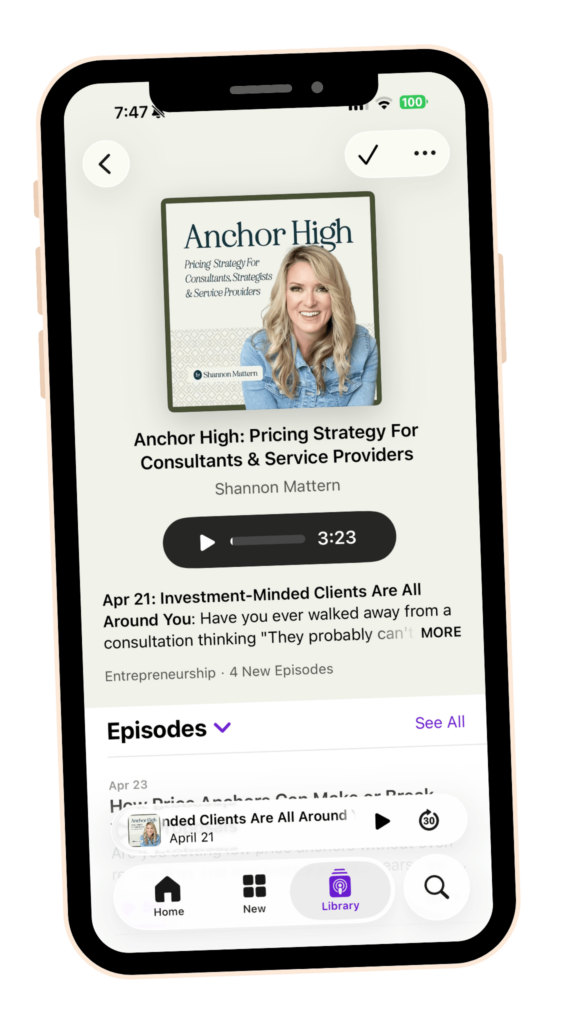
A price anchor is the first price a person hears, and every number after it gets compared to that first number. When you anchor low, with “starting at” prices, budget questions or base packages with add-ons, you frame an expense-minded decision. To anchor high, lead with the value of the outcomes and present your highest-priced option first, which is exactly how the Package Matrix™ is structured and why “charge your worth” misses the point.
Are you setting low price anchors without even realizing it?
I want you to consider this. The first price a person hears becomes the price anchor, meaning every number that’s said, seen or heard after that gets compared to that first number. So if you anchor with a low number and then prices increase from there, you’re actually framing an expense-minded decision rather than an investment-minded decision.
What is a price anchor?
A price anchor is the first price a person hears. Every number they say, see or hear after that gets compared to that first number.
How do rising prices affect buying decisions?
As a human living on this planet, especially right now, I don’t have to tell you how it feels when prices rise. It causes you to make decisions differently: to pause, to conserve, to wait, to delay, to hoard. Even if pausing, waiting, conserving, delaying or hoarding will cost you more in the long run, it feels safer to do that than to part with your resources while prices are rising.
I see service providers recreate this all the time because they think people are deciding to work with them based on price alone. So they set low anchors everywhere and frame everything around price. Then they wonder why people tell them, “No, I can’t afford it,” at any price.
What are common examples of low price anchors?
Here are some of the ways you might be setting low anchors without even realizing it:
- Listing “starting at” prices on your website
- Having tiered pricing for packages of services that starts low and goes high
- Asking about budget in the consultation
- Having a “price range for this project” question on your consultation form that starts low and goes high
- Having what people call “fit” pages to weed out tire kickers, like “if someone can’t pay me more than this, I don’t even want to talk to them”
- Packages with a base price and a bunch of add-ons that make the price go higher
And the list goes on. Every one of those things is an unintentional signal to your prospect’s brain to make an expense-minded, price-based decision: a decision based on price today instead of outcomes and results in the future.
Then when you’re frustrated that your prospects don’t see the value in what you do, you never stop to consider that you didn’t frame their decision around value from the very first moment they came across you. You framed it around price.
How do you anchor high?
The solution is to stop setting low anchors and start anchoring high. That starts before you ever talk about numbers.
It starts on your website, with removing that “starting at” price. What are you trying to protect yourself from by having those “starting at” prices on your website?
It starts with having a conversation around value. What is it costing your prospect to not solve the problem? What can they create as a result of solving the problem and working with you? You anchor high in value first.
And you don’t say low numbers first. You say high numbers first, and then you go down, and you do it in a way that is designed to not trigger sticker shock.
Why should you present your highest-priced option first?
When prices go high to low in a proposal, and you do it the right way, you’re actually mimicking the experience of prices decreasing.
Again, as a human living on this planet, I don’t need to tell you how it feels when prices decrease. We feel flush, abundant, ready to move forward and ready to make decisions. So you can intentionally design decisions that stop people from making decisions based on a pricing psychology that tells them the sky is falling and no decisions are safe.
How do you find the low anchors in your customer journey?
Your action step is to audit your customer journey. Where are you setting low anchors:
- On your website
- In your marketing
- In your emails
- In your proposal process
- In your consultation process
- On your pricing tables
Every low anchor is a place you’re leaving money on the table before the conversation to work with you even starts.
Your next step
Want to charge more for what you're already doing, without working harder, changing your business model or finding all new clients? Sign up for the free Advanced Pricing Strategy Masterclass.
Are you a business coach or consultant who works with freelancers, consultants, agencies and other types of service providers?
What if you could help your clients close more proposals at higher prices without burnout? Through my Anchor High™ Certification Program, I help business coaches, consultants and group program leaders integrate my behavioral science-backed pricing and sales strategies, frameworks and methodologies into their existing business coaching programs and client work.
Learn more and request a zero-pressure info call with me here to explore whether Anchor High™ Certification is right for you.