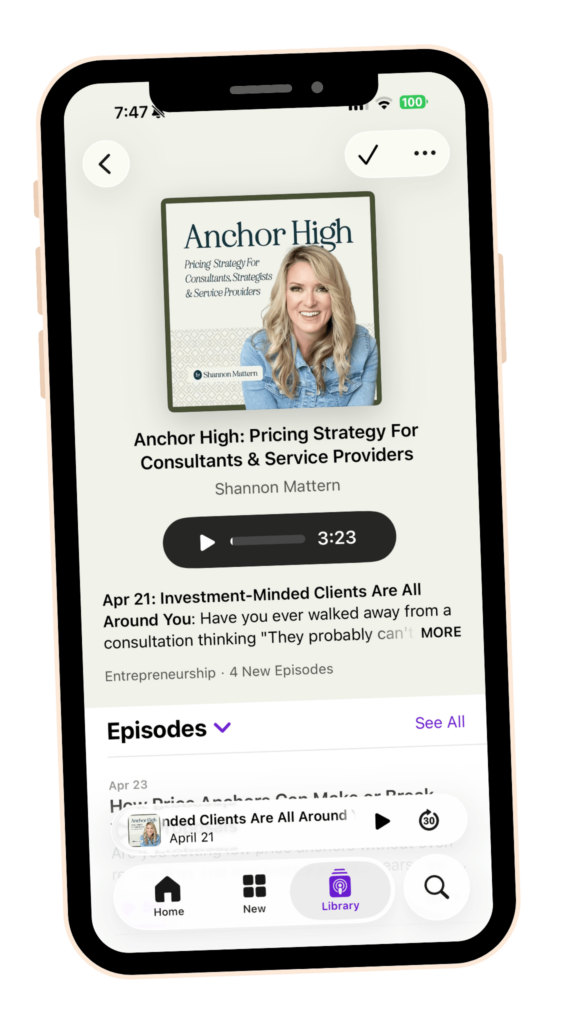
To say your price with confidence, you have to be sold on it yourself first, and that comes from pre-framing the value instead of trying to prove it. Write down 25 outcomes your clients have created and 25 costs of inaction, and talk about price only after the value of their outcomes is clear. It’s the same principle behind anchoring high in your proposals.
Do you ever get weird when you’re saying your price out loud to another person? Almost a little apologetic or even defensive, like you’re bracing yourself for the sticker shock response you think is going to happen before it ever happens?
Or maybe you say things like “I know this is probably more than you were expecting,” “I realize this might feel expensive” or “I understand it’s a big investment” to lessen the discomfort you feel when saying your price.
If you feel good about your prices on paper, but then all that confidence goes out the window when you’re sharing them with a prospective client, it’s likely because you are trying to prove the value rather than pre-frame the value.
Why do service providers lose confidence when saying their prices out loud?
If you’re bracing yourself for a sticker shock response from your clients, it might be because deep down you have sticker shock about your own prices. If you’re like most service-based businesses I meet, you are undercharging and overdelivering.
Sure, your prices might make logical sense to you math-wise on paper, but are you really sold on your prices? The first person who needs to be sold on your price is you.
How do you get sold on your own prices?
You get sold on your own prices with what I call the 25 + 25 exercise. Grab a pen and paper and:
- Write down 25 outcomes your clients have created in their lives and/or their businesses as a result of working with you. These outcomes can be financial, mental, physical, emotional, relational, time-related or freedom-related. Dig deep and get to 25.
- Then flip the script and write down 25 costs to your client of inaction. What happens mentally, physically, emotionally and financially if they choose to do nothing and maintain status quo? What happens to their time, their freedom, their flexibility? What are they missing out on if they don’t move forward, and what is it really costing them?
What is the difference between proving value and pre-framing value?
Proving value means trying to show that you, your services, your skills or the quality of what they’re getting is worth the price. Pre-framing value means showing your client the value of the outcomes and results they will experience as a result of working with you, before they ever see a number.
Your price is not about you. Yes, your price gets to be profitable and sustainable so you can deliver the service and the transformation you deliver at a high level. And yes, you are allowed to charge whatever you want to charge for your services. But when you’re talking about your price to your client, your job is to pre-frame the value of their outcomes and results.
Where should you pre-frame the value of your services?
Pre-frame the value from the very first interaction a client has with you, and back up from there:
- In the conversations they have about you before they even learn who you are
- On your website
- In your consultation call
- In your proposal
That way, when you get to the point in the process where you talk about the price, you believe at your core that the value of what you’re delivering is worth at least 10x the price, if not more.
What happens when you believe your price?
When you believe the value is worth at least 10x the price, you will not feel discomfort saying your prices to other people, and you will not need to protect yourself ahead of time from other people’s potential sticker shock. When you feel that level of confidence around your pricing, sales gets so much easier.
Your next step
Want to charge more for what you're already doing, without working harder, changing your business model or finding all new clients? Sign up for the free Advanced Pricing Strategy Masterclass.
Are you a business coach or consultant who works with freelancers, consultants, agencies and other types of service providers?
What if you could help your clients close more proposals at higher prices without burnout? Through my Anchor High™ Certification Program, I help business coaches, consultants and group program leaders integrate my behavioral science-backed pricing and sales strategies, frameworks and methodologies into their existing business coaching programs and client work.
Learn more and request a zero-pressure info call with me here to explore whether Anchor High™ Certification is right for you.